
Web pages don't keep their word. Keepword keeps the receipts.


A company rewrites its privacy policy overnight. A news article is quietly "updated". A shop shows you one price and someone abroad another. When that happens, how do you prove what the page said? A screenshot takes ten seconds to fake.
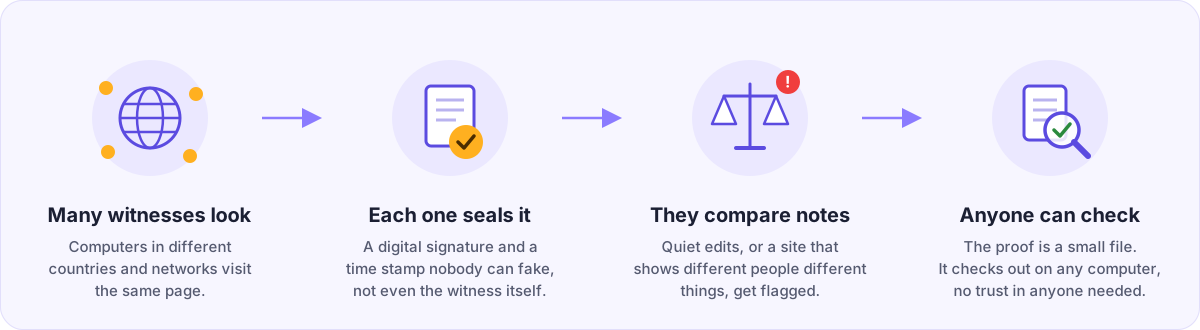
Keepword is a network of independent witnesses: computers run by different people, on different networks, in different countries. They record what a page said and when, and flag silent edits and pages that show different countries different things. Every record is sealed, and anyone can check it offline without trusting Keepword, the witnesses, or you.
Built for journalists, fact-checkers, consumer groups, lawyers and researchers, and for anyone who has ever thought "wait, that's not what it said yesterday."
The network is just starting, and every witness in a new country or network makes it stronger. A small Linux server with a domain name pointing at it is enough, and one command sets it up:
git clone https://github.com/keepword-net/keepword.git && cd keepword
sudo sh scripts/install.sh --domain witness.example.org --caddy
The installer builds Keepword, runs it as a sandboxed service with automatic TLS, and joins the network. See the network guide for what a witness needs and how to check that it's working, and the install guide for the container image and other setups.
- keepword-net/keepword: the code and a longer tour of how Keepword works. Star it to follow along.
- Design: the threat model, evidence formats and network design.
- Changelog: what changed in each release.
Keepword is free software under the GNU Affero General Public License v3.0. You may use, study, change and share it. If you run a modified version as a service for others, you must offer them its source code under the same license.