
Create PDF files and images (JPG, PNG, WEBP) from hosted templates and JSON.


npm i @ireceipt.pro/jsNote the dot in the scope: @ireceipt.pro/js, not @ireceipt-pro/js.
You need an API key and a template id, both from https://dashboard.ireceipt.pro. The template ids below are public, so you can run this before creating anything of your own.
import { IReceiptPRO } from '@ireceipt.pro/js';

const irp = new IReceiptPRO(process.env.IRECEIPTPRO_API_KEY);

const pdf = await irp.createPdfFromPublicTemplate(
  'invoice_universal_vzrt6k1s',
  { invoice: { number: '13' } }
);
pdf is a Buffer (or ArrayBuffer, depending on your runtime). Write it to
disk, stream it, attach it to an email — it is just the file's bytes.
CommonJS works the same way:
const { IReceiptPRO } = require('@ireceipt.pro/js');
const irp = new IReceiptPRO(process.env.IRECEIPTPRO_API_KEY);There is no raw HTML → PDF endpoint. Every call names a template that already lives on our side, either one of the public ones or one you author in the dashboard, and you supply the data as JSON. Nothing about your page markup is sent at request time.
Success is 201, not 200. The file's bytes are the response body. This
catches people who wrap the call in something that treats anything but 200 as a
failure.
Not everything is retried. createFile makes up to five attempts, but only
for failures a later attempt could plausibly fix: transport errors where no
response arrived at all, 5xx, 408 and 429. Any other error, a 400, 401,
403 or 404, throws on the first attempt.
The sleeps between attempts are (attempt + 1) × 1000ms, so a fully retried
failure spends 2 + 3 + 4 + 5 = 14s across four sleeps. Budget your timeout for
that number, and only for those statuses. A bad API key does not take 14
seconds; it throws almost immediately.
What the errors mean. The SDK throws an Error whose message is the
server's message; the HTTP status is not attached to it, so match on the text.
| status | message |
cause |
|---|---|---|
400 |
Invalid template name |
no template with that id in that scope (public vs your own) |
400 |
A size larger than … / A size smaller than … |
size outside the allowed range, see below |
401 |
Unauthorized |
no Authorization header. Raw HTTP only: the SDK always sends one, so an unset key (say, a missing env var) goes out as Bearer undefined and comes back as Token invalid |
403 |
Token invalid / Token expired |
the key is unknown, revoked or expired |
403 |
Limit exceeded |
your plan's monthly request limit is used up |
403 |
A size larger than 1200x1200 requires a paid subscription. |
free-plan size cap |
500 |
varies | rendering failed on our side; the SDK retries it |
None of the 4xx in this table are retried, so Limit exceeded fails fast
instead of burning another 14 seconds.
Four formats × two scopes:
| method | output | template |
|---|---|---|
createPdfFromPublicTemplate |
public | |
createJpgFromPublicTemplate |
JPG | public |
createPngFromPublicTemplate |
PNG | public |
createWebpFromPublicTemplate |
WEBP | public |
createPdfFromPrivateTemplate |
yours | |
createJpgFromPrivateTemplate |
JPG | yours |
createPngFromPrivateTemplate |
PNG | yours |
createWebpFromPrivateTemplate |
WEBP | yours |
All eight take the same arguments:
const buffer: Buffer | ArrayBuffer = await irp.createPdfFromPublicTemplate(
  templateId,
  args,
  size
);| argument | required | what it is |
|---|---|---|
templateId |
yes | from https://dashboard.ireceipt.pro. Ids are stable; template names are not, so key off the id |
args |
yes | the data substituted into the template. On the wire this field is called variables |
size |
no | { width, height } in pixels. Default A4 portrait, 796 × 1126. Up to 1200 × 1200 on the free plan; on a paid plan up to 5000 × 5000 for PDF and 3200 × 3200 for images. A PDF must be at least 100 × 210 |
There is also IReceiptPRO.useApiKey(apiKey), a static factory equivalent to
new IReceiptPRO(apiKey).
There is no package for us on PyPI, RubyGems or Packagist, so from anything that is not Node it is a plain HTTP call:
POST https://api.ireceipt.pro/v1/pdf/public/invoice_universal_vzrt6k1s
Authorization: Bearer <your api key>
Content-Type: application/json

{"variables": {"invoice": {"number": "13"}}}
The path is /v1/{pdf|jpg|png|webp}/{public|private}/{templateId}; an unknown
format segment is a 404, an unknown scope a 400 Invalid template type. Besides
variables and size, the body accepts format (a4-portrait, a5-landscape,
… a1 to a7), which takes precedence over size; the SDK does not send it.
201, with the PDF bytes as the response body. The full OpenAPI specification is
published at https://api.ireceipt.pro/openapi.yml, with a browsable reference
at https://api.ireceipt.pro/.
Node ≥ 16. Dual ESM/CJS with type declarations for both. One dependency
(axios). MIT.
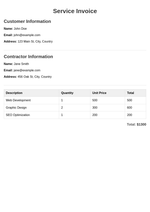
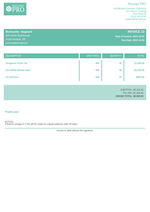
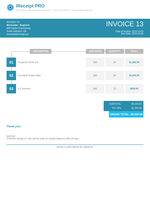
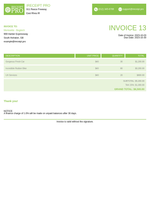
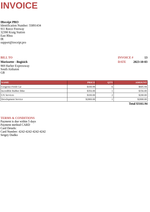
Public templates you can call today. Each image links to a live sandbox where you can change the data and re-render it in the browser.
 |
 |
 |
 |
 |
To author your own, or to find more ids, sign in at https://dashboard.ireceipt.pro.
The four-line call at the top is the whole API. This is what a real invoice payload looks like once the template is actually being filled:
import { IReceiptPRO } from '@ireceipt.pro/js';

const irp = new IReceiptPRO(process.env.IRECEIPTPRO_API_KEY);

await irp.createJpgFromPublicTemplate("invoice_universal_vzrt6k1s", {
  "invoice": {
    "number": "13",
    "date": "2023-10-03",
    "table": {
      "headers": ["NAME", "PRICE", "QTY", "AMOUNT"],
      "rows": [
        { "values": ["Gorgeous Fresh Car", "$100.99", "6", "$605.94"] },
        { "values": ["Incredible Rubber Bike", "$356.00", "1", "$356.00"] },
        { "values": ["UX Services", "$100.00", "2", "$200.00"] },
        { "values": ["Development Service", "$2000.00", "1", "$2000.00"] }
      ]
    },
    "total": "$3161.94",
    "terms": [
      "Payment is due within 5 days",
      "Payment method CARD"
    ]
  },
  "from": {
    "companyName": "IReceipt PRO",
    "lines": ["Identification Number: 55891434", "support@ireceipt.pro"]
  },
  "to": {
    "companyName": "Morissette - Bogisich",
    "lines": ["969 Harber Expressway", "South Aishaton", "GB"]
  },
  "localization": {
    "invoice": "INVOICE",
    "bill_to": "BILL TO",
    "date": "DATE",
    "total": "Total",
    "terms_and_conditions": "TERMS & CONDITIONS"
  }
}, {
  "width": 796,
  "height": 1126
})
Which keys a template expects is a property of that template — open its sandbox to see the shape it wants.

MIT.