

xOverlay is a high-performance polygon Boolean engine specialized for orthogonal (Manhattan) geometry. It processes contours made exclusively of horizontal and vertical edges using integer coordinates.
Warning
xOverlay is experimental. Until 1.0, breaking API changes may be released in new 0.x minor versions.
- Why xOverlay?
- Union Algorithm Walkthrough
- Features
- Getting Started
- Boolean Operations
- Fill Rules
- Input and Output
- Integer Types
- Multithreading
- Performance Characteristics
- xOverlay and iOverlay
- Project Status
- License
xOverlay is specialized for orthogonal geometry, making many workloads 10–20× faster than general-purpose polygon libraries.
Use xOverlay for axis-aligned edges with integer coordinates. For arbitrary angles or floating-point input, use iOverlay.
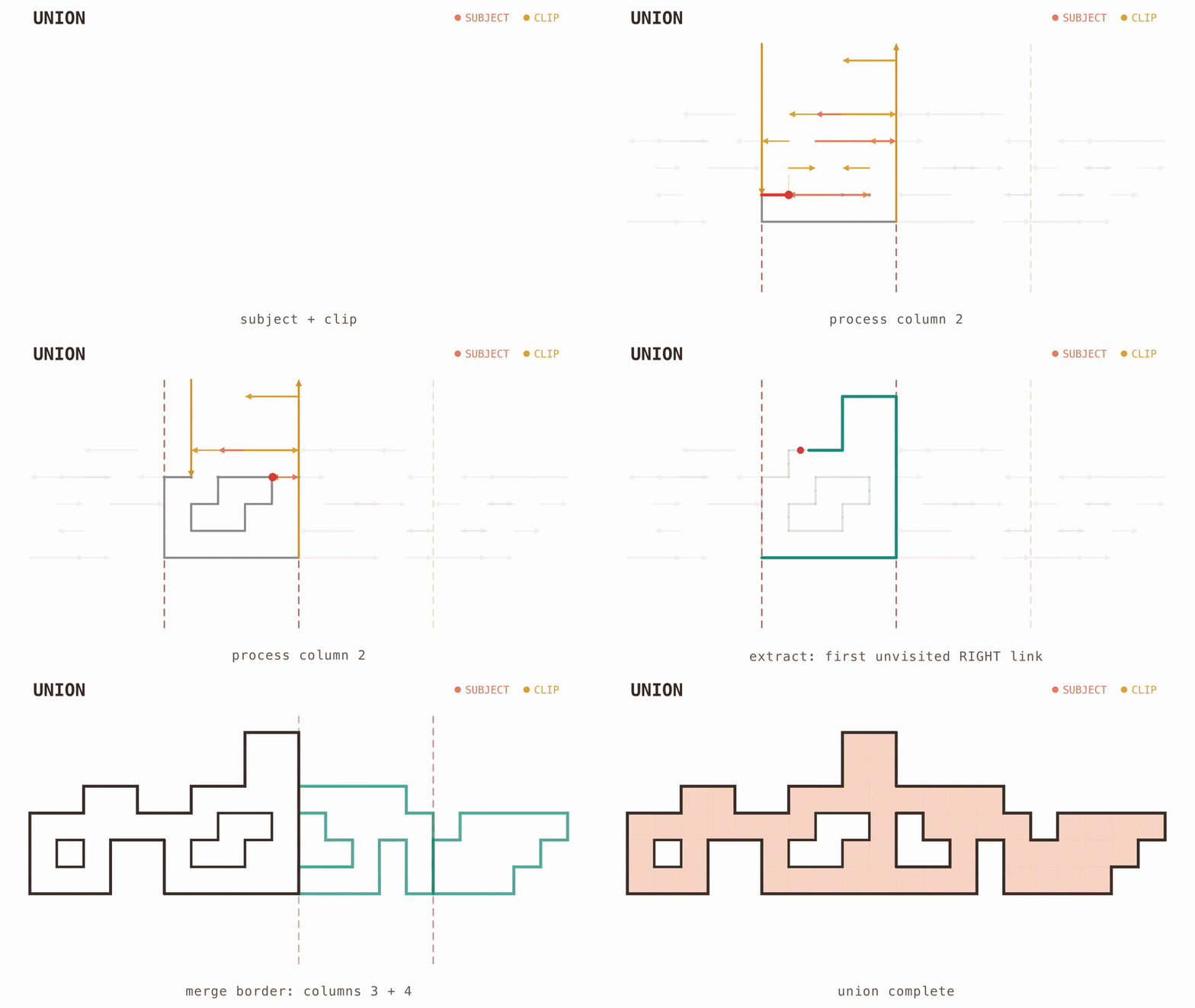
The animation below follows union processing from directed input segments through column-graph construction, contour extraction, and border-contour merging.
- Boolean operations: union, intersection, difference, inverse difference, and XOR.
- Single-input extraction: resolve a subject or clip using its fill rule.
- Orthogonal geometry: a solver specialized for horizontal and vertical edges.
- Multiple contours and holes: output can be returned as shapes with their holes or as a flat contour list.
- Fill rules: even-odd, non-zero, positive, and negative.
- Integer coordinates:
i16,i32, andi64, preserved from input to output. - Configurable winding counts:
i16by default, withi32andi64available for deep overlap. - Optional parallel execution: enabled by default for large inputs.
no_stdcore: available when default features are disabled.
xOverlay requires Rust 1.88 or later. Add version 0.1.0 from crates.io:
[dependencies]
x_overlay = "0.1.0"use x_overlay::core::fill_rule::FillRule;
use x_overlay::core::overlay::Overlay;
use x_overlay::core::overlay_rule::OverlayRule;
use x_overlay::i_float::int::point::IntPoint;
let subject = vec![vec![
IntPoint::new(0_i32, 0),
IntPoint::new(8, 0),
IntPoint::new(8, 6),
IntPoint::new(0, 6),
]];
let clip = vec![vec![
IntPoint::new(4_i32, 2),
IntPoint::new(10, 2),
IntPoint::new(10, 8),
IntPoint::new(4, 8),
]];
let result = Overlay::<i32>::with_contours(&subject, &clip)
.overlay(OverlayRule::Intersect, FillRule::NonZero);
assert_eq!(result.len(), 1);
assert_eq!(result[0].len(), 1);Contours are closed automatically; do not repeat the first point at the end.
Overlay is a one-shot value. Construct a new Overlay to execute another
Boolean rule for the same input contours.
For subject A and clip B, xOverlay supports:
| Rule | Result |
|---|---|
OverlayRule::Subject |
Filled area of A |
OverlayRule::Clip |
Filled area of B |
OverlayRule::Intersect |
A ∩ B |
OverlayRule::Union |
A ∪ B |
OverlayRule::Difference |
A − B |
OverlayRule::InverseDifference |
B − A |
OverlayRule::Xor |
Area belonging to exactly one of A or B |
Subject and Clip are also useful for resolving self-overlapping contour sets according to the selected fill rule.
The fill rule determines which regions of a contour set are considered filled:
| Rule | Filled region |
|---|---|
FillRule::EvenOdd |
Regions with an odd crossing count |
FillRule::NonZero |
Regions with a non-zero winding number |
FillRule::Positive |
Regions with a positive winding number |
FillRule::Negative |
Regions with a negative winding number |
NonZero is the default choice for consistently oriented outer contours and holes. EvenOdd is useful when contour orientation should not affect nesting.
Each subject and clip is a slice of contours. A contour is a Vec<IntPoint<I>> and must follow these rules:
- Every edge, including the closing edge, must be horizontal or vertical: consecutive points must have the same
xor the sameycoordinate. - A contour must contain at least four points.
- Adjacent points should be distinct; duplicates are accepted with a validation warning.
- The contour is closed automatically; the first point does not need to be repeated at the end.
- Coordinates must use one supported integer type consistently.
xOverlay's core solver assumes valid orthogonal input. It does not validate contour length, axis alignment, closing-edge alignment, or other structural invariants, and it does not return validation errors. Supplying invalid contours may produce invalid geometry.
Import the Contour trait to validate input before constructing an Overlay:
use x_overlay::core::validation::Contour;
use x_overlay::i_float::int::point::IntPoint;

let contour = vec![
    IntPoint::new(0_i32, 0),
    IntPoint::new(10, 0),
    IntPoint::new(10, 10),
    IntPoint::new(0, 10),
];

let warnings = contour.validate().expect("invalid orthogonal contour");
assert!(warnings.is_empty());
Validation rejects contours with fewer than four vertices or non-orthogonal edges, including the
implicit closing edge. Zero-length edges and redundant collinear vertices are valid and are
returned as ContourWarning values.
Self-intersections, winding direction, nesting, and relationships between contours are not checked;
these are handled according to the selected fill rule.
Custom contour representations can implement Contour by providing their length and indexed point
access. A higher-level checked wrapper can use the same trait to validate subject and clip contour
collections while keeping validation out of the performance-oriented solver path.
Overlay::overlay returns IntShapes<I>, which is equivalent to:
Vec<                 // shapes
    Vec<             // contours in one shape
        Vec<Point>   // points in one contour
    >
>
For each shape:
- the first contour is the outer boundary;
- remaining contours are holes;
- by default, outer boundaries are counterclockwise and holes are clockwise.
When shape-to-hole grouping is not needed, use overlay_contours:
use x_overlay::core::fill_rule::FillRule;
use x_overlay::core::overlay::Overlay;
use x_overlay::core::overlay_rule::OverlayRule;
use x_overlay::i_float::int::point::IntPoint;

let subject = vec![vec![
    IntPoint::new(0_i32, 0),
    IntPoint::new(8, 0),
    IntPoint::new(8, 6),
    IntPoint::new(0, 6),
]];
let clip: Vec<Vec<IntPoint<i32>>> = Vec::new();

let contours = Overlay::<i32>::with_contours(&subject, &clip)
    .overlay_contours(OverlayRule::Subject, FillRule::NonZero);
The returned Vec<IntContour<I>> keeps outer boundaries and holes separate; their winding direction distinguishes them.
xOverlay supports i16, i32, and i64. The coordinate type is explicit on Overlay and is preserved in the result:
use x_overlay::core::fill_rule::FillRule;
use x_overlay::core::overlay::Overlay;
use x_overlay::core::overlay_rule::OverlayRule;
use x_overlay::i_float::int::point::IntPoint;

let subject = vec![vec![
    IntPoint::<i64>::new(5_000_000_000, 0),
    IntPoint::new(5_000_000_010, 0),
    IntPoint::new(5_000_000_010, 10),
    IntPoint::new(5_000_000_000, 10),
]];

let result = Overlay::<i64>::with_contours(&subject, &[])
    .overlay(OverlayRule::Subject, FillRule::NonZero);

assert_eq!(result.len(), 1);The coordinate type and winding-count type are independent:
use x_overlay::core::fill_rule::FillRule;
use x_overlay::core::overlay::Overlay;
use x_overlay::core::overlay_rule::OverlayRule;
use x_overlay::i_float::int::point::IntPoint;

let subject = vec![vec![
    IntPoint::new(0_i64, 0),
    IntPoint::new(10, 0),
    IntPoint::new(10, 10),
    IntPoint::new(0, 10),
]];

// i64 coordinates with i32 winding counts.
let result = Overlay::<i64, i32>::with_contours(&subject, &[])
    .overlay(OverlayRule::Subject, FillRule::NonZero);

assert_eq!(result.len(), 1);
Overlay<I> uses i16 winding counts by default. This is the most compact option and is
appropriate when every intermediate subject and clip winding count remains within
-32768..=32767. Choose Overlay<I, i32> or Overlay<I, i64> for inputs with deeper nesting or
more overlapping contours. Winding arithmetic follows the overflow behavior of the selected Rust
integer type.
The allow_multithreading feature is enabled by default. Overlay::with_contours automatically chooses the available parallelism. Use the custom constructor when execution must be controlled explicitly:
use x_overlay::core::cpu_count::CPUCount;
use x_overlay::core::overlay::Overlay;
use x_overlay::i_float::int::point::IntPoint;

let subject = vec![vec![
    IntPoint::new(0_i32, 0),
    IntPoint::new(8, 0),
    IntPoint::new(8, 6),
    IntPoint::new(0, 6),
]];
let clip: Vec<Vec<IntPoint<i32>>> = Vec::new();

let overlay = Overlay::<i32>::with_cpu_count(
    &subject,
    &clip,
    CPUCount::Single,
);
CPUCount::Auto uses the number of threads in the current Rayon thread pool. To use a specific
thread count, create a Rayon pool and construct and execute the overlay inside
ThreadPool::install. CPUCount::Fixed only supplies a solver layout hint and does not
reconfigure the Rayon thread pool.
Disable default features for a serial no_std build:
[dependencies]
x_overlay = { version = "0.1.0", default-features = false }
See the published interactive performance report
for deterministic iOverlay, xOverlay, and Boost Polygon 90 comparisons. The generators,
raw JSON, scripts, and usage guide live in the repository's
performance/benchmark
directory.
xOverlay uses a column-partitioned scanline solver with a compact, contiguous active topology. This design is optimized for spatially distributed Manhattan geometry with batched topology changes, as commonly found in EDA layouts, routing data, grids, and rectilinear CAD workloads. Column partitioning keeps the active topology local while contiguous storage provides predictable memory access and good cache utilization.
Runtime is sensitive to the distribution of edges across scanlines. Deeply nested
contours[^nested-squares] are a worst-case pattern: an input may contain O(N) distinct scanlines
while retaining an O(N) active topology and changing only a small part of it on each line.
Repeated updates to that topology can therefore approach O(N²) work. More uniformly distributed
EDA geometry typically changes a larger portion of each local topology and benefits more from
column partitioning, so this nested pattern is not expected to represent the primary target
workload.
Each partitioned column graph uses u32 node indices and can therefore contain at most 2³² nodes
(indices 0..=u32::MAX). This limit applies independently to each column graph, not to the total
number of input edges. If a column graph would exceed the limit, xOverlay panics instead of
truncating an index. Available address space and allocation limits may impose a lower practical
limit.
| xOverlay | iOverlay | |
|---|---|---|
| Edge directions | Horizontal and vertical only | Arbitrary |
| Coordinate APIs | i16, i32, i64 |
Integer and floating point |
| Primary goal | Maximum throughput on orthogonal geometry | General-purpose robust polygon overlays |
| Project maturity | Experimental (0.1.x) | Production-ready |
If geometry may contain diagonal edges, use iOverlay.
xOverlay 0.1.x is under active development and is not API-stable. Before adopting it in
production, pin an exact tested crate version (for example, =0.1.0) and validate the output
against representative workloads.
xOverlay is distributed under the MIT License.