

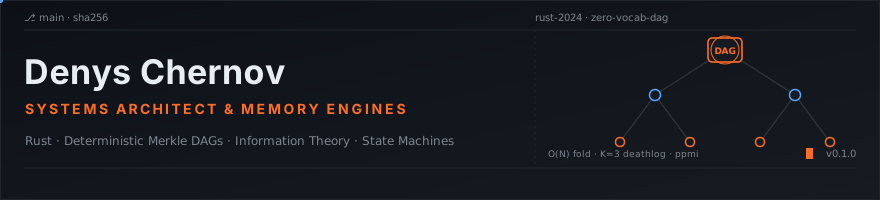



Systems engineer and memory architecture researcher. I design deterministic, low-level associative memory engines in Rust that turn raw byte streams into cryptographic Merkle DAGs, and I have a strong preference for mathematical invariants over opaque neural black boxes.
Most modern cognitive systems rely on multi-gigabyte vector databases, floating-point embeddings that drift with every checkpoint, and fragile prompt scaffolding. I build zero-vocabulary state machines where memory is byte-exact, compression is calculated online, and active working memory is bounded by provable temporal reachability.
Day to day:
- Rust (2024 Edition) — memory arenas, zero-copy byte streams, lock-free concurrency, deterministic data structures
- Merkle DAGs & Cryptographic Interning — SHA-256, BLAKE2, bottom-up concept emergence from raw factory bytes
-
ACID Embedded Storage — single-transaction durability via
redb, memory mapping viamemmap2 -
Information Theory & Surprise — online surprise calculation (
$S_{\text{static}}, S_{\text{growth}}$ ), streaming greedy folding$O(N)$ - Graph & Co-occurrence — sparse PPMI matrices, associative recall, biased random walks
Opinions I hold quietly:
- If a system cannot explain its internal state without querying another LLM, it is not a memory engine—it is a cache with opinions
- Vector databases are often an expensive workaround for the lack of a proper emergent grammar
- Generational GC without sweep (
$K=3$ temporal root reachability) is all the forgetting an agent needs - 100 passing deterministic tests beats a 1,000-line prompt every single day
- If state is not byte-exact and reproducible, debugging it is just guesswork
axmg — Universal Merkle DAG Associative Memory Engine for Rust. Embedded, deterministic, zero-vocabulary associative memory engine. Replaces heavyweight vector databases with an online cryptographic DAG, dynamic working memory (
axiom — Foundations of associative cognitive structures, byte-level tokenization, and emergent linguistic topologies.
axmv2 — Explorations in multi-agent memory synchronization and temporal graph evolution.
Currently formalizing Model Context Protocol (MCP) bridges so autonomous agents can plug directly into deterministic associative memory without middleware overhead, and exploring zero-alloc arena compaction for long-running streaming daemons.
Open an issue or start a discussion on any of the repositories above. For architectural inquiries or collaboration on deterministic memory engines, reach out via GitHub or email.
Deterministic · Byte-exact · Built with Rust