A coding agent that jails model commands and uses editable state machines for long-running tasks.
The model can write code and ask to run commands, but those commands go through a jail with restricted filesystem and network access. Long-running workflows can be written, reviewed, edited, resumed, and replayed as declarative state machines instead of being left to an open-ended agent loop.
Full documentation: agent6.dev
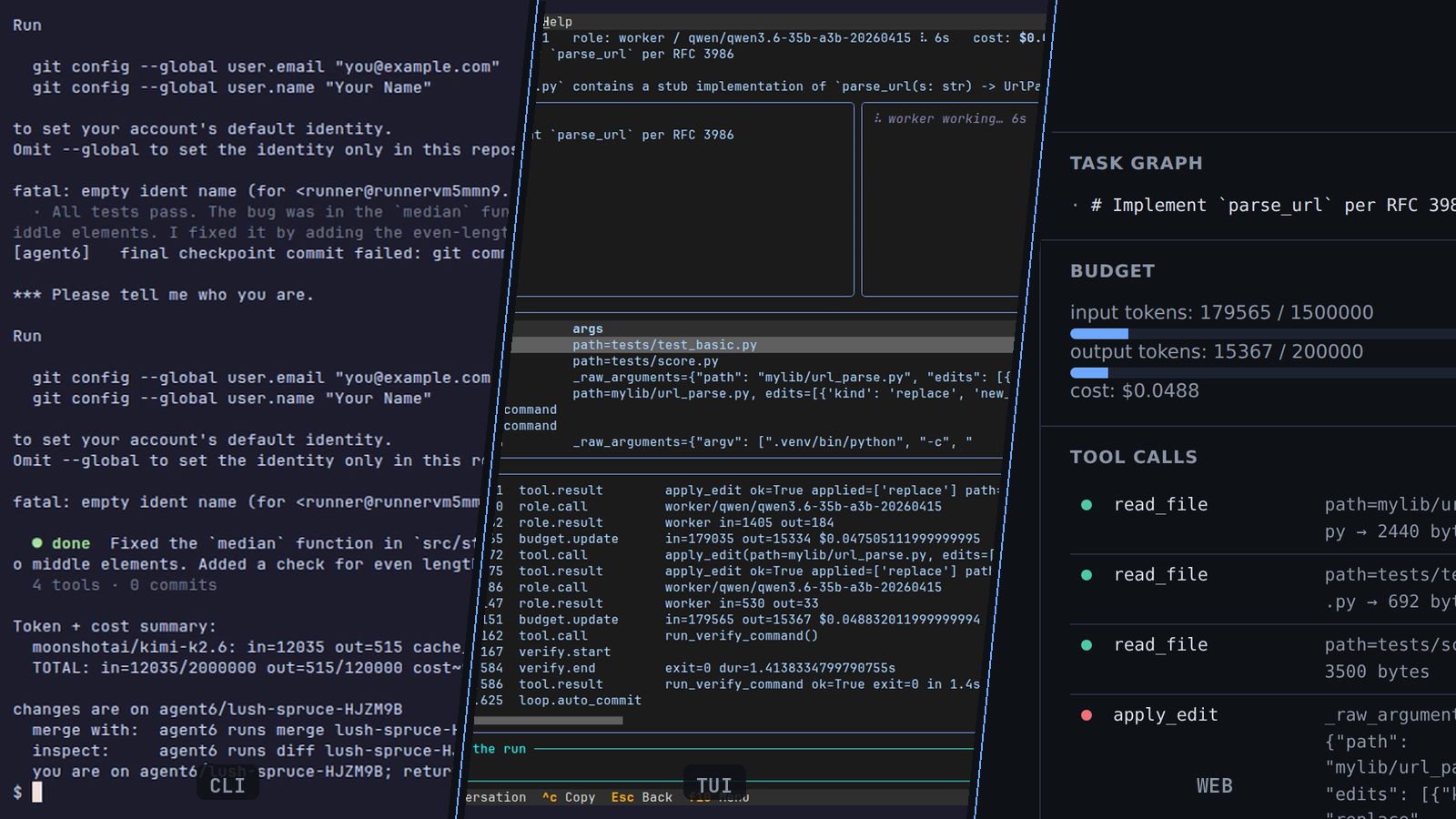
- Sandboxed execution for every LLM-chosen child process, jailed individually
with Landlock + seccomp; the default
strictisolation adds namespaces +pivot_root, rebinds.gitread-only, and confines egress to your provider - Works with Anthropic and any OpenAI-compatible endpoint (OpenAI, OpenRouter, Ollama, vLLM, llama.cpp, LM Studio)
- Per-step git commits, snapshot-resumable runs, per-turn forkable checkpoints, a hard metered USD budget with a token fallback for calls the meter cannot price
- Plan, run, review, and ask modes; a live terminal dashboard, a zero-dependency
browser UI (
agent6 web, phone-friendly), and an editor-driven ACP agent (agent6 acp); persistent transcripts and a searchable run history - Sessions build on each other:
--from <session-id>seeds a new run or ask with another session's context (the source is untouched -- keeping a session's mode isfork), a session can read this project's other sessions, and/btw <question>asks a one-off question beside a live run without interrupting it -- the answer prints whole at the next turn boundary and stays resumable as the ask it is - Long jobs do not hold a turn open:
run_backgroundstarts a slow build or a watcher,read_backgroundpolls it,/shellslists what a run started and how each one ended, and nothing a run started outlives it - Transparent, steerable context compaction: every surface shows what left the
model's context, and the conversation view shows the summary a restart
continued from;
/compact [focus]compacts on demand,/pin <text>makes an instruction survive compaction verbatim, andagent6 memory pinkeeps a load-bearing memory in every run's prompt (trimmed last, under the block's cap) - State machines (
agent6 machine) for long-running automated tasks: LLM-drafted, operator-reviewed, journaled, and replayable; they can pause for operator input, accept events, be steered from any front-end, and notify you when they need attention - Skills: install standard SKILL.md packs (superpowers, caveman, any
agentskills.io repo) with
agent6 skills install <url>; they index into the system prompt, load on demand via a read-only tool, and fire as/namepause-menu commands orrun --skill; nothing in a skill is ever executed. The format is shared with Claude Code and Pi, and[skills].extra_dirsloads an existing~/.claude/skills-style collection in place. Repo instructions are read fromAGENTS.md(a repo usingCLAUDE.mdcan symlink it) - Small, fixed LLM tool surface; the only extension point is operator-configured MCP servers, off by default
- Eight runtime dependencies, no telemetry, no auto-update
- Parallel fan-out (
agent6 run --parallel N|model-a,model-b): N isolated clone-based lanes run independently, each an ordinary sandboxed run; results auto-compare (reviewer-model judge, else verify+cost) into a ranked report. Nothing auto-merges;agent6 sessions merge <id>picks a winner.agent6 sessions compare <id> <id> ...runs the same ranked comparison over any past runs. The web/TUI composer and a live-run steer share one grammar,/parallel [N|models] <task>(repeat the token to queue more tasks), to dispatch and join a sibling group mid-conversation
uv tool install agent6 # or: pipx install agent6agent6 needs Linux for the sandbox (kernel 6.7+ for TCP rules), Python 3.12+, and an API key for at least one provider. macOS runs unsandboxed behind a warning; on Windows use WSL. See installation for the full requirements and building from source.
# Connect a provider once (stored in ~/.config/agent6/, key in a 0600 secrets file).
# Already connected on this machine? Skip both; `agent6 check` verifies it.
agent6 connect                # interactive: pick provider, paste API key
agent6 model worker anthropic claude-sonnet-4-6

# Run the agent on a task. agent6 infers a verify command if you haven't set one.
cd your-repo
agent6 run "add a --json output mode to the CLI"

# Watch and drive runs from a terminal, a full-screen TUI, a browser, or an editor.
agent6 attach <session-id>        # follow + answer a run live (default: conversation view; --raw for the event stream)
agent6 tui                    # full-screen dashboard hub
agent6 web                    # browser UI on http://127.0.0.1:7658 (phone-friendly)
agent6 acp                    # speak ACP on stdio; an editor spawns this

# Audit the effective config, pre-flight the sandbox, resume or fork a run.
agent6 config show
agent6 check
agent6 resume <session-id>
agent6 fork <session-id> --at-turn 7
That is the whole loop. See getting started for the full command tour, the web UI for driving runs from a phone, configuration for every field, and the security model for what the sandbox enforces.
Config is layered: built-in secure defaults, then the global ~/.config/agent6/config.toml,
then the per-repo config (out of the workspace, per-machine, not committed), then an
explicit --config FILE. Every field has a default; security-sensitive fields default to
the safe value (tool_network = "auto",
run_commands = "ask", protect_git = true), and git_ops.py
refuses push, --force, and history rewrites unconditionally.
Reproducible harnesses live under bench/. The headline one is the
cross-model sweep (bench/sweep): replicated runs on real-world
tasks, scored out-of-band by each project's own test suite, reported with
confidence intervals for success rate and cost plus a latency comparison.
Also there: real-world
SWE-bench-Lite-style tasks, head-to-head runs against Claude Code / opencode /
aider, machine create validation, and a perf-optimization harness. The
recorded numbers in those are mostly small-n exploratory runs; re-run before
quoting.
Read AGENTS.md first. The repo's verify command decides whether a change is landable:
uv run ruff check && uv run ruff format --check && \
  uv run pyright && uv run tach check && uv run pytest
Adding a tool, loosening a security default, dialling a new network destination, or
changing the jail (src/agent6/jail/) requires a Security review note: paragraph in
the commit message.