foambryo infers the relative surface tensions and cell pressures of foam-like cell aggregates (early embryos, tissues, organoids) from the 3-D geometry of their cells.
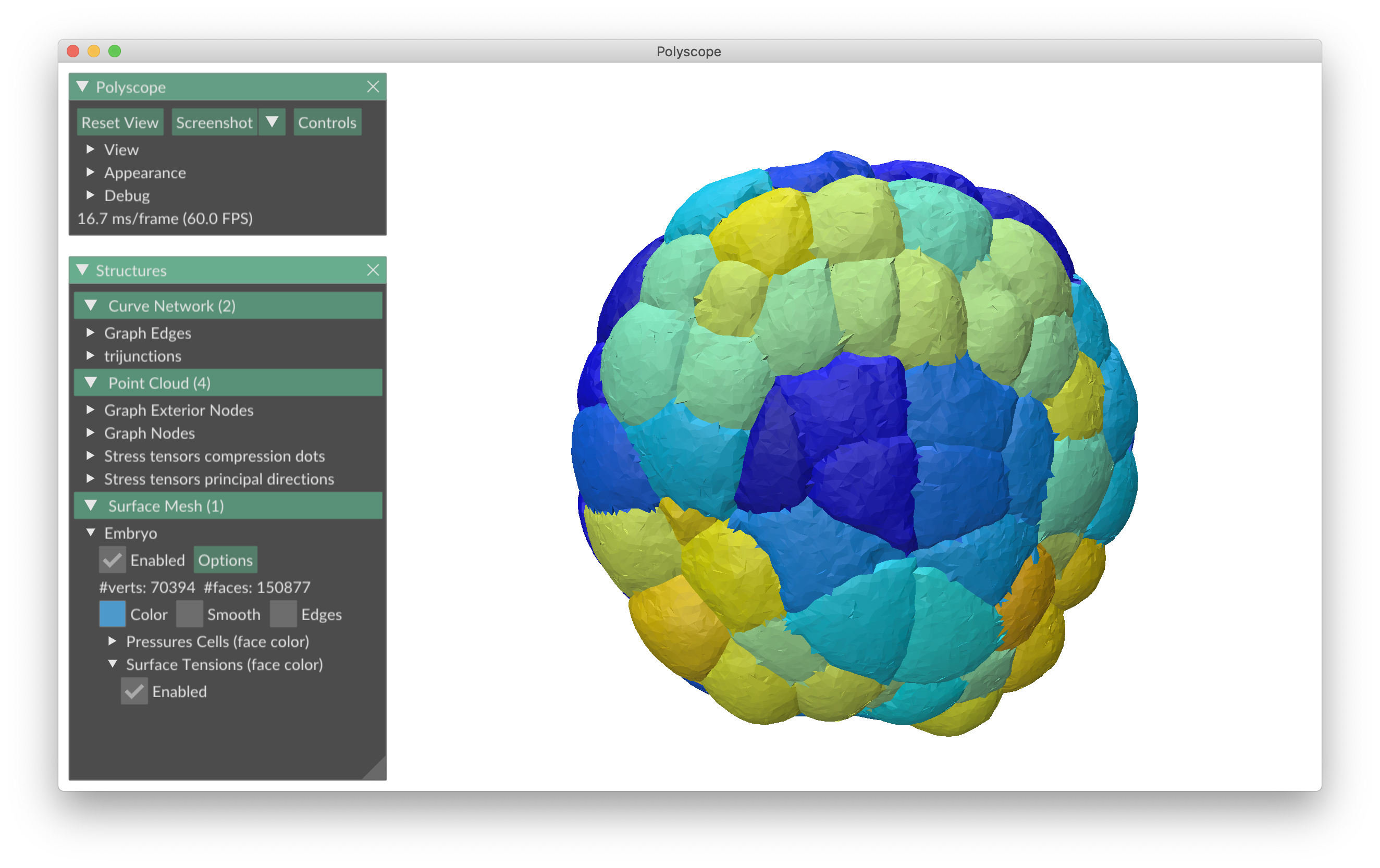
It was developed by Sacha Ichbiah during his PhD in Turlier Lab, and is maintained by Matthieu Perez and Hervé Turlier. For support, please open an issue. If you use it in your work, please cite the article: Ichbiah S., Delbary F., McDougall A., Dumollard R., Turlier H. Embryo mechanics cartography: inference of 3D force atlases from fluorescence microscopy. Nature Methods 20(12), 1989–1999 (2023).
To infer tensions in 2-D, see foambryo2D.
The documentation (user guide, examples, API reference) is in docs/; the full list of changes is in the CHANGELOG, and what can mislead you in the release notes.
0.7.0 is the first release on PyPI since 0.5.1; it includes everything prepared for 0.6.0, which was not published. Install foambryo and delaunay-watershed-3d 0.7.0 together.
- Cropped tissues. Where the image cuts the tissue, the mesh's crop faces are kept out of every equation, and the pressures of the cut cells are
naninstead of wrong numbers. - Masks with anisotropic voxels. Give the voxel size (
spacing=(dz, dy, dx)) and the mask is resampled to cubic voxels before meshing, which was measured to be more accurate than meshing the native grid. - Large tissues. Sparse solves above 2 000 unknowns, a
solveroption, a table of every linear solve, and an estimate of the reconstruction's time and memory before it runs. - The normalisation is exact. The returned tensions now have exactly the requested mean (
mean_tension); tension ratios are unchanged, but the overall scale of the tensions (and so of the pressures) changes by one factor per mesh, by up to 1.4 % forYoungDupre. - Seed ensembles.
infer_tensions_over_seedsreconstructs a mask at several dither seeds and averages the tensions; their spread is a lower bound on the error. - A command line,
foambryo mesh,infer,infer-over-seedsandview, for batch runs. - The viewer draws its colour bars, a length scale bar, explodes and cuts the tissue, saves figures, exports the values, and can start from a mask. Tensions are coloured blue–grey–red around the mean tension; pressures with a trimmed
magma; undetermined values in green. - A napari plugin, napari-foambryo, released with 0.7.0 as its version 0.1.0:
pip install "napari[all]" napari-foambryo. - Fixes that change results: meshes of cells that touch the image border (their border triangles were wound the wrong way, in delaunay-watershed-3d);
ForceBalanceMAPno longer depends on the mesh's length unit; cells that no Laplace equation determines getnan;Cotan,InvCotan,LamiandLogLamileave out flat junction lines (wedges of exactly 0 or 180 degrees) instead of breaking; the first-order error bars include a term they missed and are documented as a lower bound.
foambryo needs Python 3.11 or later. Install it from PyPI, in a virtual environment:
pip install foambryo                 # the library
pip install "foambryo[viewing]"      # and the Polyscope viewer (Polyscope, matplotlib)
pip install "foambryo[cli]"          # and TIFF masks for the foambryo command (tifffile)
pip install "foambryo[viewing,cli]"  # both
Every dependency, delaunay-watershed-3d included, is installed by pip. The napari plugin is installed with pip install "napari[all]" napari-foambryo. For development, clone the repository and pip install -e "./foambryo[viewing,cli]". Tested for 0.7.0 on macOS 14 on Apple silicon (arm64), with Python 3.12; other systems are expected to work but were not tested for this release.
foambryo starts from a segmentation mask: a 3-D array of integer labels, one per cell, 0 for the medium, axis 0 being z. Make it with any segmentation tool (a watershed, Cellpose, …); its quality and resolution set the precision of the result.
In Python: reconstruct the mesh, infer the tensions and pressures, look at them.
import tifffile                                # pip install "foambryo[viewing,cli]"
from foambryo import dcel_mesh_from_segmentation_mask, infer_forces
from foambryo.viewing import plot_force_inference

mask = tifffile.imread("segmentation.tif")                               # axis 0 is z
mesh = dcel_mesh_from_segmentation_mask(mask, spacing=(1.0, 0.5, 0.5))  # voxel size (dz, dy, dx), in um
tensions, pressures = infer_forces(mesh)       # {(label_1, label_2): tension}, {label: pressure}
plot_force_inference(mesh, tensions, pressures, length_unit="um")
On the command line: the same, from files, with the same numbers.
foambryo mesh segmentation.tif --spacing 1.0 0.5 0.5 -o tissue.rec
foambryo infer tissue.rec -o results
foambryo view tissue.rec --results results
In napari, with the napari-foambryo plugin: File › Open Sample › foambryo › Benchmark case 000, then Plugins › foambryo › Reconstruct, Infer and Results (see the plugin's README).
More: the examples (anisotropic voxels, cropped tissues, seed ensembles, large tissues, the command line, the viewer) and the introductory notebook.
Polyscope (foambryo[viewing]) |
napari (napari-foambryo) |
|---|---|
 |
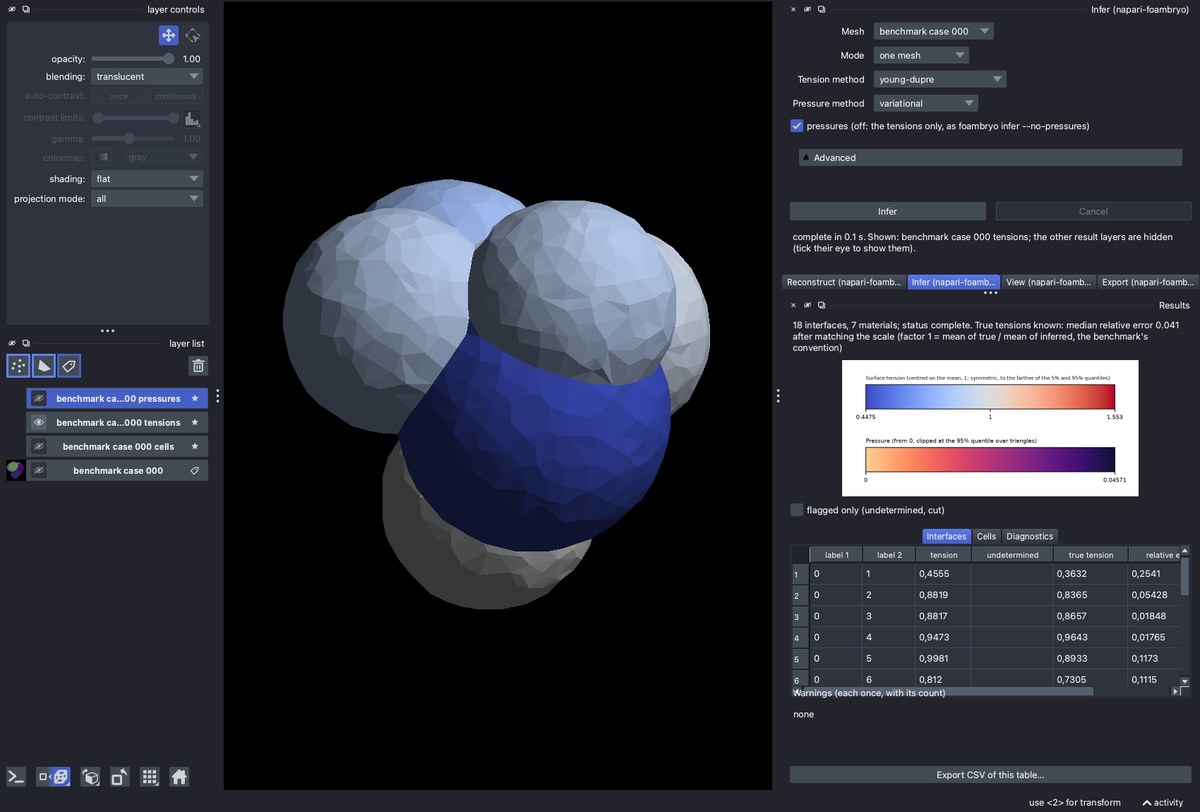 |
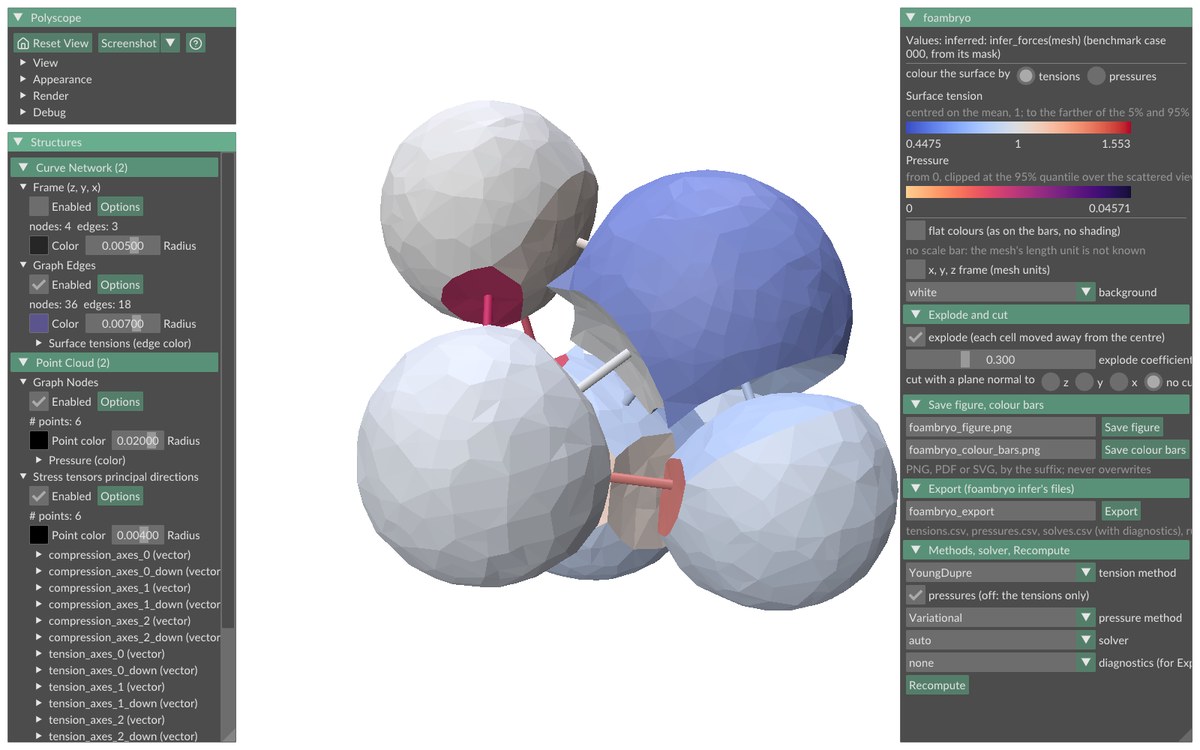
Benchmark case 000 (a simulated 6-cell aggregate), reconstructed from its mask and inferred with the defaults; the tensions on the surface, with the same colour bar in both viewers.
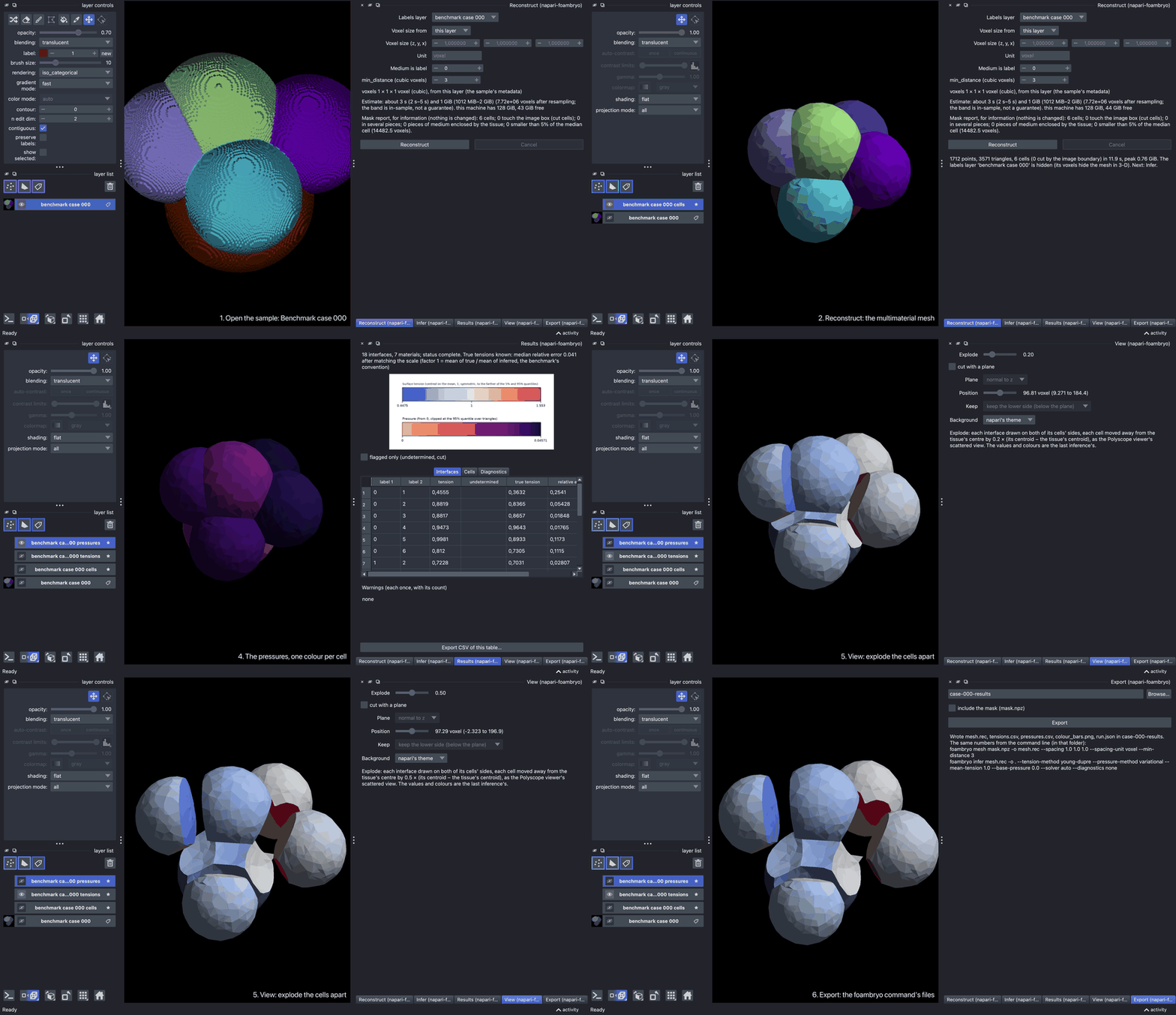
The same case in napari-foambryo, from the mask to the exported files: Reconstruct, Infer, Results, the pressures, View's explode slider, Export.
Both viewers draw what the library returns, with the library's colours, so a value has the same colour in both. The Polyscope window (foambryo view, or plot_force_inference and the other plot_* functions) shows the colour bars and a length scale bar, explodes and cuts the tissue, changes the methods and recomputes, saves figures and exports the values; foambryo view MASK --spacing DZ DY DX starts from the mask and reconstructs it in the window. See the viewers guide.
We consider a tissue made of cells i, which minimise, under conservation of their volumes, an energy
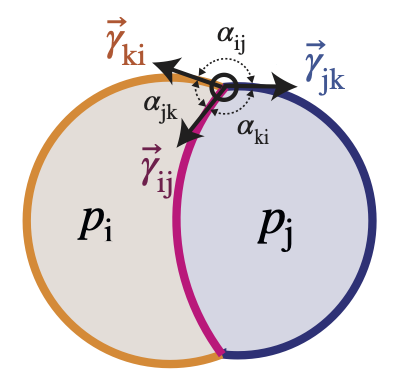
Two laws follow:
-
Young-Dupré:
$\gamma_{ij}\vec t_{ij} + \gamma_{ik}\vec t_{ik} + \gamma_{jk}\vec t_{jk} = \vec 0$ along each junction line between cells i, j and k, where$\vec t_{ij}$ is the unit vector tangent to the interface between i and j, normal to the line and pointing away from it; -
Laplace:
$p_j - p_i = 2 \gamma_{ij} H_{ij}$ , where$H_{ij}$ is the mean curvature of that interface.
Angles fix only the ratios of the tensions, and the Laplace law only the differences of the pressures. So the tensions are normalised: their mean is mean_tension (1 by default), exactly, in each connected piece of the junction graph. The pressures are relative to the medium's, base_pressure (0 by default), in units of tension per length unit of the mesh. An interface with no junction line (a closed surface) has no measurable tension: it is nan, never a number.
foambryo offers thirteen tension methods (YoungDupre, the default, reads the contact angles; others invert a global operator) and three pressure methods (Variational, the default, Laplace, WeightedLaplace); see the methods guide. A short methods note says what each method computes (the unknowns and conventions, the angle-based and force-balance methods, the pressures, the diagnostics and error bars) and how to read the results.
- Cropped tissues. Where a cell reaches the image box, the mesh closes it with crop faces, which are not contact with the medium. Every tension method keeps them out of its equations; the pressures of the cells they cut are
nan, with aCutCellPressureWarning; the Laplace pressure methods refuse a cropped mesh. A tissue that really ends on an image face (a coverslip):physical_image_faces=("axis0_low",). See cropped tissues. - Anisotropic voxels. Give the voxel size. Measured on simulated tissues whose cells are as small as real ones, down-sampled along z, against the same tissues meshed at full resolution: resampling to cubic voxels first costs +0.83, +0.71 and +1.17 degrees of contact-angle error at an anisotropy of 5/3, 2 and 3, against +1.38, +1.97 and +4.10 for meshing the native grid (BENCHMARKS.md). Above 3 nothing was measured, and a warning says so. The cost is that of a mask acquired at the short spacing. See anisotropic voxels.
- Large tissues.
foambryo.reconstruction_costestimates the reconstruction's time and memory before it runs (a 1 866-cell tissue resampled to cubic voxels: 13.5 minutes and 38 GiB on the machine measured). The tension and pressure systems are solved sparsely from 2 000 unknowns (solver="auto");diagnostics=Truereturns a record of every solve. On a 1 866-cell tissue the sparse solve took 9 s and 1 GiB where the dense one took 6 to 9 minutes and 14–18 GiB, and they agree to 1.5e-11. See large tissues. - Seed ensembles. delaunay-watershed-3d dithers its points with a seed; another seed gives slightly different tensions.
infer_tensions_over_seeds(mask)averages eight reconstructions: it lowered the median tension error from 0.152 (a single seed, on average) to 0.123 on synthetic tissues with cells of real size. The seed spread is a lower bound on the error, not an error bar: a single seed's ±1 SD interval held the true tension for about half of the interfaces. Interfaces found by fewer than half of the seeds are flagged.combine="angles"is experimental: on synthetic masks degraded by a smooth random warp of about one voxel, it lost its advantage over the default on tissues of 90 and 165 cells while keeping it on small aggregates. See seed ensembles. - Error bars.
infer_tensions_with_uncertaintygives intervals with their measured calibration; none is a calibrated error bar on a reconstructed mesh, and the first-order one ofYoungDupreis a lower bound. It stops at about 1 300 cells of real size, where its dense diagnostics outgrow scipy, and says so at once.
foambryo mesh MASK --spacing DZ DY DX -o MESH.rec      # reconstruct (TIFF needs foambryo[cli])
foambryo infer MESH.rec -o OUTDIR                      # tensions.csv, pressures.csv, run.json
foambryo infer MESH.rec -o OUTDIR --no-pressures       # the tensions only
foambryo infer MESH.rec -o OUTDIR --diagnostics basic  # and solves.csv, one row per linear solve
foambryo infer-over-seeds MASK --spacing DZ DY DX -o OUTDIR   # a seed ensemble
foambryo view MESH.rec --results OUTDIR                # the Polyscope window
Every default is the library's: foambryo infer gives the numbers of infer_forces(dcel_mesh_from_file(MESH)), bit for bit, and run.json records the versions, the options and the equivalent Python call. The spacing has no default, because a wrong spacing changes every angle without any other sign. Every option, file, column, exit code and message is in the command-line specification.
Phallusia mammillata is a solitary marine tunicate of the ascidian class, known for its stereotypical development. Its embryo develops freely, so its tensions, pressures and stresses can all be inferred. Segmentation data from Guignard, L., Fiúza, U. et al.
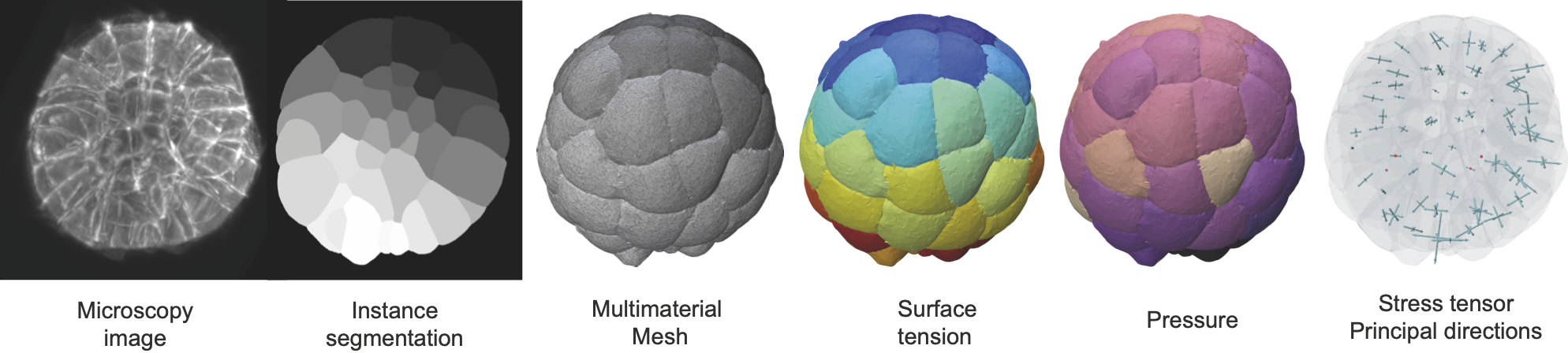
The Caenorhabditis elegans embryo develops within a shell of unknown shape and mechanics, so its pressures are not accessible, but the Young-Dupré law still gives the surface tensions. Segmentation data from Cao, J., Guan, G., Ho, V.W.S. et al.

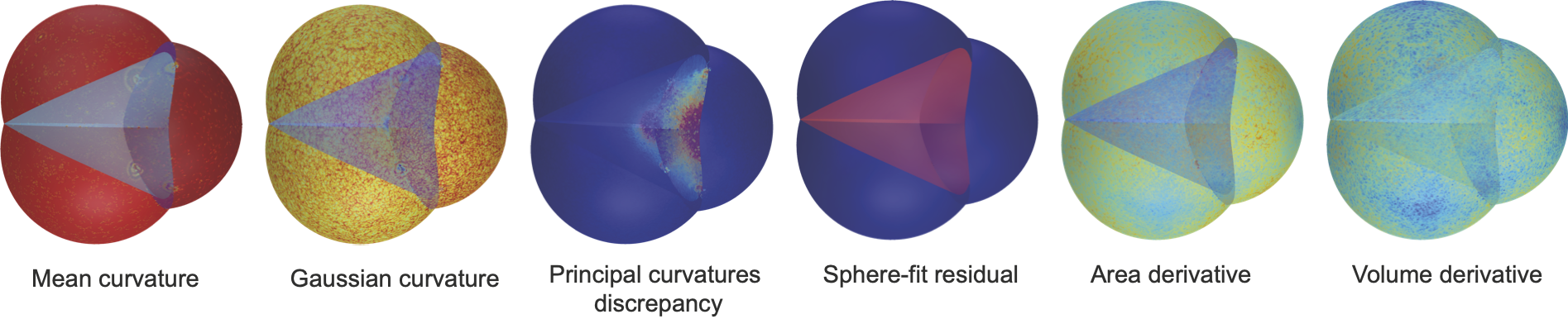
With scalar_quantities=True, the viewer also draws the Gaussian curvature (angle defect), the mean curvature (cotangent formula), the vertex area and volume derivatives, the difference between the principal curvatures and the residual of the best sphere fit.
The development repository also holds the project's research record (working notes, exploratory scripts and their results), for provenance. It is not part of the distribution: pip install does not ship it, and nothing under foambryo imports from it.
If you use this tool, please cite the associated article: Ichbiah S., Delbary F., McDougall A., Dumollard R., Turlier H. Embryo mechanics cartography: inference of 3D force atlases from fluorescence microscopy. Nature Methods 20(12), 1989–1999 (2023), doi:10.1038/s41592-023-02084-7. Contact Matthieu Perez and Hervé Turlier for practical questions and applications.
Recent work on dw3d and foambryo is part of a collaboration with Alejandro Aguilera Castrejon (Janelia Research Campus, Howard Hughes Medical Institute). We thank him and his Janelia colleagues Adam L. Taylor, Wenhong Li and Francesco Roncato. Adam L. Taylor found the border-triangle winding defect fixed in 0.6.0 and pointed us to the seed-extraction and dense tension-solve bottlenecks on large tissues.
@article{Ichbiah2023,
  author    = {Ichbiah, Sacha and Delbary, Fabrice and McDougall, Alex and Dumollard, R{\'e}mi and Turlier, Herv{\'e}},
  title     = {Embryo mechanics cartography: inference of {3D} force atlases from fluorescence microscopy},
  journal   = {Nature Methods},
  volume    = {20},
  number    = {12},
  pages     = {1989--1999},
  year      = {2023},
  month     = dec,
  publisher = {Springer Science and Business Media LLC},
  issn      = {1548-7105},
  doi       = {10.1038/s41592-023-02084-7},
  url       = {https://doi.org/10.1038/s41592-023-02084-7}
}foambryo is free software: you can redistribute it and modify it under the terms of the GNU General Public License, version 3 or (at your option) any later version (SPDX GPL-3.0-or-later); the text is in License. This covers versions 0.5.0 and later; earlier releases keep the licence they were published under (CC BY-NC-SA 4.0).