


A TypeScript port of Cursory by Vinyzu, with the same algorithms, the same recorded-trajectory database, and the same licence. A given seed produces the same trajectory here as it does in Python — see Parity with the Python original.
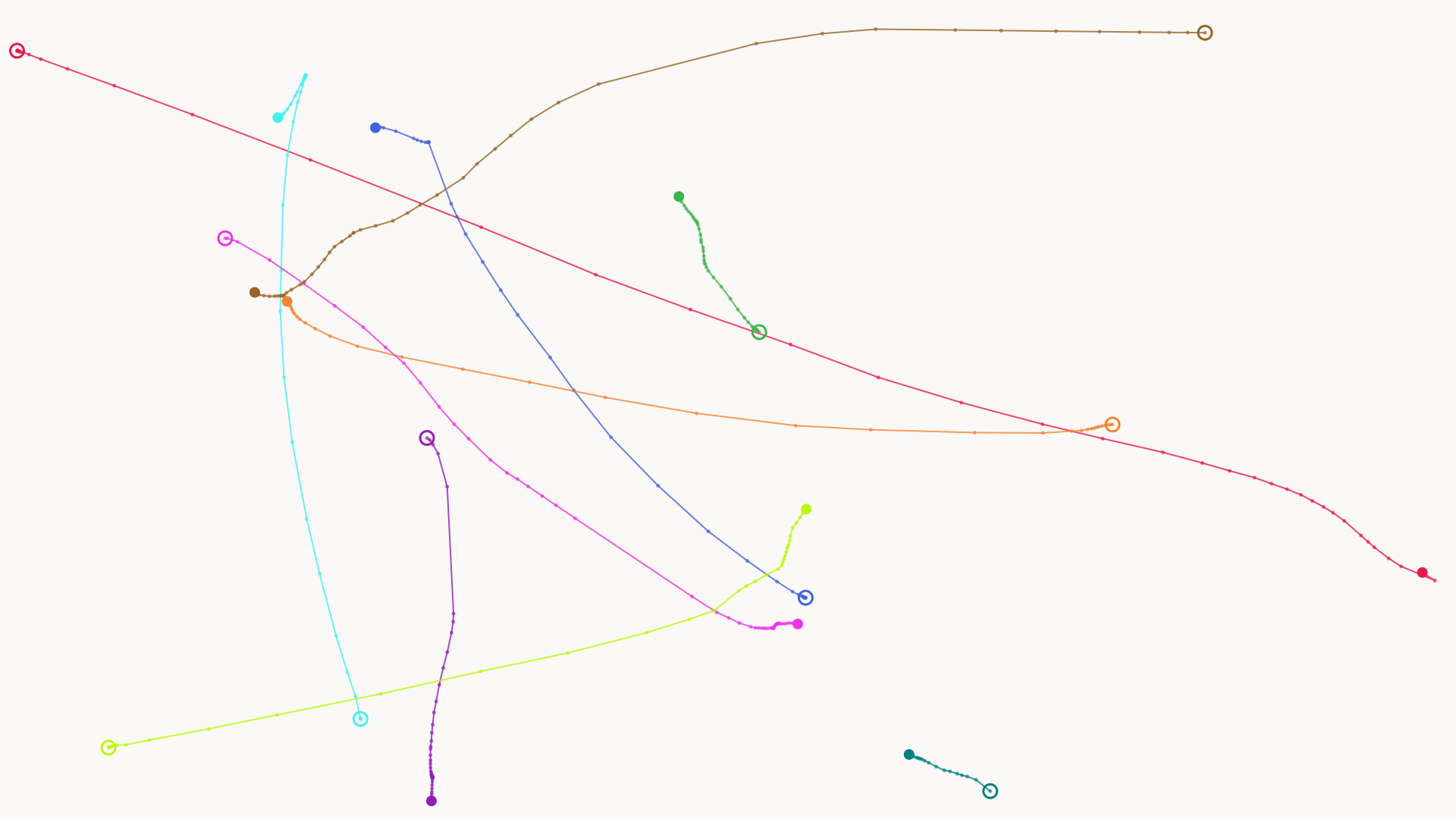
Ten trajectories at the default 60 Hz. Hollow circles start, filled circles finish, and each dot is one sample — so dots bunch up where the cursor slowed down and spread out mid-flight.
npm install cursory-jsNode 18 or newer. TypeScript types are included.
import { generateTrajectory } from 'cursory-js';

const { points, timings } = generateTrajectory([120, 80], [940, 560]);

for (const [index, point] of points.entries()) {
  const pause = timings[index] - (timings[index - 1] ?? 0);
  console.log(`wait ${pause}ms, then move to ${point[0]}, ${point[1]}`);
}
points[i] is the position to move to, and timings[i] is how many
milliseconds after the start of the movement to be there. Both arrays are the
same length, timings starts at 0 and never goes backwards, and the first and
last points are exactly the start and end you asked for.
require('cursory-js') works too.
Dispatch each move without awaiting it, and pace the loop yourself:
import { generateTrajectory } from 'cursory-js';

const { points, timings } = generateTrajectory(from, to, { frequency: 60 });
const cdp = await page.context().newCDPSession(page);
const start = performance.now();

for (let i = 0; i < points.length; i += 1) {
  // Not awaited: see below.
  void cdp
    .send('Input.dispatchMouseEvent', { type: 'mouseMoved', x: points[i][0], y: points[i][1] })
    .catch(() => {});

  const next = timings[i + 1];
  if (next !== undefined) {
    await sleep(next - (performance.now() - start));
  }
}
Do not await page.mouse.move() per sample. Awaiting waits for the browser
to acknowledge the event, and it acknowledges on its rendering cadence. Measured
against headless Chromium 140: a median of 16.67 ms per awaited move, which
is exactly one 60 Hz frame. At 60 Hz that is the entire budget between samples,
so 44% of moves overrun their deadline and the trajectory plays back stretched —
losing the timing that made it look human in the first place. Awaiting raw CDP
costs the same 16.6 ms, so "drop to CDP" is not the fix; not awaiting is.
Dispatched without awaiting, the same trajectories play back within 0.05% of their intended duration. The browser coalesces a few events when they arrive faster than it renders, which is what a real mouse does too.
examples/playwright.mjs is a complete, runnable
version, and it reports its own drift so you can measure your setup rather than
trust these numbers.
const first = generateTrajectory([0, 0], [500, 300], { seed: 42 });
const second = generateTrajectory([0, 0], [500, 300], { seed: 42 });
// first and second are identical
Without a seed, each call draws fresh OS entropy.
| Parameter | Type | Description |
|---|---|---|
targetStart |
[number, number] |
Where the cursor starts. |
targetEnd |
[number, number] |
Where the cursor ends up. |
| Option | Type | Default | Description |
|---|---|---|---|
frequency |
number |
60 |
Samples per second. |
frequencyRandomizer |
number |
1 |
Largest jitter, in milliseconds, applied to each sample time. |
seed |
number | bigint |
— | Seed for a reproducible trajectory. Seeds above Number.MAX_SAFE_INTEGER must be a bigint. |
directness |
number |
0.65 |
Relative preference for shorter, straighter paths, from 0 to 1. |
Returns { points: [number, number][], timings: number[] }.
Throws a RangeError if frequency is not positive, frequencyRandomizer is
negative, or directness is outside 0 to 1. A zero-length movement returns a
single point at timings 0 without consuming any randomness.
directness moves the whole distribution rather than filtering it: at 1 the
straight, efficient recordings are preferred, at 0 the wandering ones, and
either extreme stays reachable at any setting.
findTrajectory, findNearestTrajectory, findClosestTrajectory,
morphTrajectory, jitterTrajectory, knotTrajectory,
generateMiddleBiasedPoint, LOADED_TRAJECTORIES, and defaultGenerator are
exported as well — the equivalents of Python's cursory.trajectory_selection.
They take a generator from defaultGenerator(seed) where the Python versions
take an rng argument.
- Find a close human trajectory. A database of thousands of trajectories recorded from real people, searched for the closest match to the requested movement, with some randomisation.
- Morph it. Scaled, rotated and translated onto the requested endpoints exactly, while keeping the shape of the original.
- Add noise. Jittered and knotted, so positions vary slightly and the path cannot be recognised by hashing it.
- Regenerate with timings. Resampled at the requested frequency using the recording's own interval pattern, with noise added to the sample times.
- Re-add noise. Jittered and knotted again, since resampling smooths the path out.
- Morph again. Put back onto the requested endpoints exactly.
Warning
It is theoretically possible to detect trajectories generated by Cursory, but doing so would take an infeasible amount of compute. The greater risk is a bad trajectory, which the algorithms above are what mitigate.
This is a port, not a rewrite, and it is tested against output recorded from
Python Cursory 2.0.0 — see test/parity.test.ts and
scripts/generate-parity-fixtures.py,
which regenerates the fixtures.
Random numbers match bit for bit. Cursory's output is driven entirely by
numpy.random.default_rng(seed), so this package reimplements the parts of
numpy that reach the result: the PCG64 bit generator, SeedSequence, the ziggurat
normal sampler with numpy's own constant tables, Lemire's bounded-integer method
and its rejection loop, weighted choice, and pairwise summation. The test
suite checks 12 seeds across every distribution, and hashes a 200,000-draw
normal stream, against values numpy produced. A seed that drew even one
different number would give a different trajectory, not a slightly different
one, so this is the part that has to be exact.
Coordinates match to about 1.4 × 10⁻¹² px. Over 490 randomised movements —
85,506 coordinates — the largest difference in any one of them was 1.36e-12 px,
and 80% were identical bit for bit. The residue is exp, atan2, sin and
cos rounding differently in V8 than in the C library numpy and CPython call,
which is also why the parity test compares coordinates to a tolerance rather
than exactly. math.hypot is reproduced exactly, using CPython's own
vector_norm, because the distance between the endpoints feeds everything
downstream.
Those are measurements, not estimates, and npm test prints its own:
149 trajectories, 23512 coordinates: worst gap 1.36e-12 px, 77.8% bit-identical
The committed fixture holds 149 movements to keep the repository small.
python scripts/generate-parity-fixtures.py --cases 500 regenerates it at any
size, and the suite re-measures rather than repeating the figure above.
About 0.2% of movements pick a different recording. When two recordings score exactly the same, numpy's ordering comes from an unstable sort whose SIMD kernel is chosen at run time — so Python itself does not always agree with Python across CPUs. This port breaks those ties by index instead, which is deterministic everywhere. In 3,000 sampled queries, 5 disagreed with numpy, and every one of them was an exact tie; there were no disagreements without one. A tie means the recordings were equally good matches, so the result is equally valid, just not the same one.
The fixture generator excludes any movement that hit a tie anywhere — about 2% of them, since each movement runs 21 candidate queries — so the checked-in expectations never depend on the CPU that produced them.
One quirk of the original is reproduced on purpose. numpy types an array of
recorded whole-pixel coordinates as int64, so the original's
np.zeros_like(tangents) is an integer array, and storing unit normals in it
rounds them to 0 and ±1. Most recordings in the database are whole-pixel, so
this shapes most of the jitter Cursory actually produces. jitterTrajectory
does the same thing for whole-pixel input. Removing it would be a different
library, not a bug fix.
Behaviour is the same; the surface is TypeScript-idiomatic.
| Python | TypeScript |
|---|---|
generate_trajectory(start, end, frequency, frequency_randomizer, seed, directness) |
generateTrajectory(start, end, { frequency, frequencyRandomizer, seed, directness }) |
returns (points, timings) |
returns { points, timings } |
rng keyword argument |
a Generator from defaultGenerator(seed), passed positionally |
ValueError |
RangeError |
npm install
npm test          # unit, behaviour and parity tests
npm run coverage
npm run build
node examples/plotTrajectories.mjs   # writes examples/trajectories.svg
Regenerating the parity fixtures needs the Python original:
pip install "cursory==2.0.0" "numpy~=2.3"
python scripts/generate-parity-fixtures.pyCursory © Vinyzu. This port © Jake Writer. Both under GNU LGPL v3 or later.
All Cursory versions are retroactively dual-licensed under LGPLv3-or-later and GPLv3-or-later. Commercial use is allowed, but the source, licence and copyright have to be made available. No liability or warranty is provided.
NOTICE credits the recorded-trajectory data and the numpy and
CPython algorithms this port reimplements.
Vinyzu, for Cursory.
Pointergeist, for helping Vinyzu understand
mouse trajectories better.
sameelarif, for
Scribe.
Margit Antal, Norbert Fejer and Krisztian Buza,
for SapiMouse.
MIMIC-LOGICS, for
Mouse-Synthesizer.
This repository is provided for educational purposes only.
No warranties are provided regarding accuracy, completeness, or suitability for any purpose. Use at your own risk — the authors and maintainers assume no liability for any damages, legal issues, or warranty breaches resulting from use, modification, or distribution of this code.
Any misuse or legal violations are the sole responsibility of the user.