

I build models and the data infrastructure they depend on — the part most models never survive. Four years inside enterprise operational data, then two building ML systems and full-stack products end to end.



flowchart LR
A["<b>Sources</b><br/>regulator filings<br/>ServiceNow ITSM<br/>Excel · CSV · APIs"]
B["<b>Ingest & validate</b><br/>Python · pandas · ADF<br/>rule-based QA gate<br/>schema drift caught early"]
C[("<b>Modelled store</b><br/>PostgreSQL · tidy fact tables<br/>indexes · row-level security")]
D["<b>Features & training</b><br/>scikit-learn · TensorFlow<br/>imbalance handling<br/>GridSearchCV tuning"]
E["<b>Evaluate</b><br/>per-class metrics<br/>held-out benchmark<br/>threshold chosen for the cost"]
F["<b>Serve</b><br/>Next.js APIs · Power BI<br/>Streamlit · RPC endpoints"]
A --> B --> C --> D --> E --> F
C --> F
style C fill:#131E33,stroke:#4F9CF9,color:#E6EDF7
style D fill:#131E33,stroke:#34D399,color:#E6EDF7
style E fill:#131E33,stroke:#34D399,color:#E6EDF7
A model is the easy half. The half that decides whether it survives contact with reality is everything to its left and right — where the data comes from, whether you can trust it, what metric you actually optimise, and who consumes the output.
Both of these are as much about judgment as accuracy — choosing the metric that matches the cost of being wrong, and saying plainly where the work falls short.
| Project | The engineering call | Result |
|---|---|---|
| Space Object Classification Orbital elements → object type |
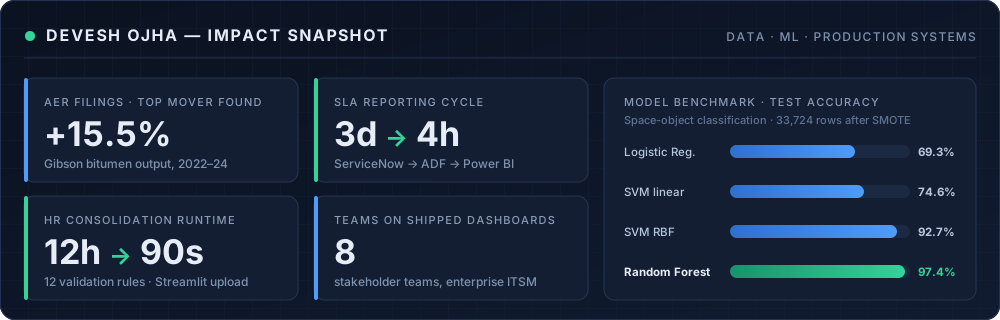
Debris massively outnumbers rocket bodies, so accuracy rewards a model that predicts "debris" forever. Balanced with SMOTE to 8,431/class, benchmarked four algorithms under GridSearchCV, and read the result through per-class precision and recall. The linear-SVM-to-RBF jump (74.6% → 92.7%) is the real finding: the boundary in orbital-element space is non-linear. |
97.4% held-out, Random Forest |
| Pediatric Pneumonia Detection Chest X-ray triage |
In triage a false negative costs far more than a false alarm, so recall is the objective, not accuracy. VGG19 transfer learning because the dataset is far too small to learn filters from scratch; augmentation, BatchNorm, Dropout and EarlyStopping as the brakes on a high-capacity backbone. | ~88% accuracy, VGG19 base |
Each README ends with what I would do differently — SMOTE belongs inside the CV fold, macro-F1 beats accuracy on a resampled set, a clinical model needs Grad-CAM and external validation before anyone trusts it. Knowing where your own work is weak is the difference between a benchmark and an engineer.
| Project | The hard part | Stack |
|---|---|---|
| CheaperRx · live ↗ Canadian prescription price comparator |
Authorisation lives in Postgres, not the app. Row-level security on all eight tables, so a bug in a React component cannot leak another user's medication list. Stripe webhooks are the only writer of paid entitlement. Drug search runs on GIN full-text indexes rather than LIKE scans. |
Next.js 14 TypeScript PostgreSQL Supabase Stripe |
| Project | The hard part | Stack |
|---|---|---|
| Alberta Oil Sands Analysis Regulator filings → queryable model |
Alberta's regulator publishes ST39 as a document: months across the page, commodities stacked down it. Unpivoting three annual workbooks into one tidy fact table — 9 operators × 36 months × 9 commodity streams — is what makes every measure a one-line aggregation. Findings are reproducible from the committed dataset, and the README states the grain defect I have not fixed yet. | Python pandas Power BI |
| HR Analytics Pipeline 12 hours/week of manual Excel, deleted |
A 12-rule validation gate that fails loudly instead of silently corrupting downstream reports — a pipeline that quietly accepts bad data is worse than the manual process it replaced. Streamlit front door so analysts self-serve. | Python pandas Streamlit |
🔎 Try the data yourself — devesh0508.github.io holds an interactive chart over the AER fact table my ETL produced. Pick an operator and the +15.5% figure above recomputes in your browser.
ML & AI scikit-learn TensorFlow / Keras transfer learning SMOTE · imbalanced-learn GridSearchCV pandas · NumPy
Data & platform PostgreSQL Azure Data Factory Supabase Power BI ServiceNow SQL Server
Languages Python SQL / T-SQL TypeScript DAX M / Power Query
Product & infra Next.js 14 Stripe Vercel Docker Streamlit Git
Independent builds & analytics projects — Sep 2025 – present, Calgary AB Shipped CheaperRx end to end: schema, row-level security model, Stripe billing, SEO, deployment. Built the AER ST39 ETL and Power BI model now published with reproducible findings.
Post-Baccalaureate Diploma, Applied Data Science — Thompson Rivers University, Sep 2023 – Sep 2025 Full-time. Machine learning, statistical methods and applied data engineering; the pneumonia-detection and space-object projects were produced here.
Business Analyst, Cognizant Technology Solutions — Jan 2020 – Jul 2023, client: John Deere IT Infrastructure Power BI semantic layer adopted by 8 Finance, Ops and IT teams, cutting a three-day reconciliation to four hours. Azure Data Factory pipelines ingesting 70,000+ records per cycle. Diagnosed a SQL aggregation defect distorting $50M+ investment reporting and cut metric variance 50% in 30 days. Designed the 12-rule data quality framework behind the HR pipeline above.
B.Tech, Electronics & Instrumentation Engineering — MAKAUT, 2015 – 2019
Certifications Power BI Data Analytics (Simplilearn) · Modernizing Data Lakes & Warehouses on Google Cloud (Coursera) · Azure AI Fundamentals AI-900 (Microsoft)
Open to AI/ML Engineer, Data Engineer and Senior Analyst roles in Canada. Work authorised · based in Calgary · available immediately